Veneer, Crown, or Filling — What’s the Difference and Which One Do You Need?
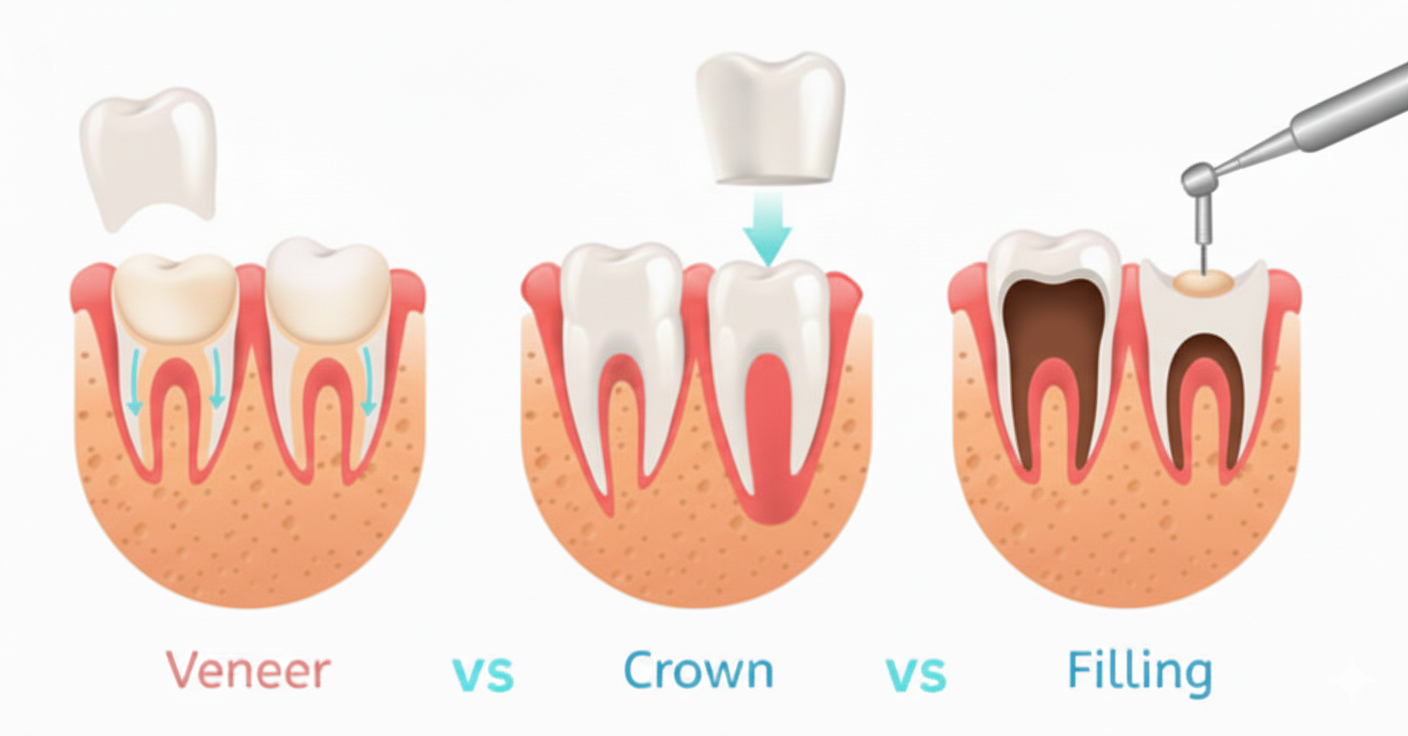
If you’ve ever sat in a dentist’s chair and nodded along without fully understanding what was being recommended — you’re not alone. Dental terminology can feel like a foreign language. And when you’re trying to make a decision about your teeth, the last thing you want is to feel confused or pressured.
This guide exists to change that. Dr. Rita Kanbar of Lebanon Dental Studio breaks down three of the most commonly recommended dental treatments — composite fillings, veneers, and crowns — in plain, honest language. By the end, you’ll know exactly what each one is, what it does, when it’s the right choice, and how they compare to one another.
No jargon. No pressure. Just clarity.
First: Why Does the Right Treatment Choice Matter?
Choosing the correct treatment isn’t just about cost — it’s about preserving as much of your natural tooth as possible while achieving the outcome you want. A treatment that’s too aggressive removes healthy tooth structure you can never get back. A treatment that’s too conservative may not solve the problem or give you the aesthetic result you’re after.
That’s why understanding your options matters. The right choice depends on the condition of your tooth, what’s causing the problem, and what result you’re hoping for.
Composite Filling: The Conservative Fix
What is it?
A composite filling is a tooth-colored resin material applied directly to a tooth, shaped to restore its form, and hardened with a special light. The process typically takes a single appointment and requires no lab work.
When is it the right choice?
Fillings are used when a tooth has a cavity or a small chip that needs to be repaired. They are the most conservative option — requiring the least removal of natural tooth structure. If the damage is minor, a composite filling is almost always the starting point.
They’re also used for small cosmetic improvements: closing minor gaps, reshaping a slightly chipped edge, or subtly improving the color of a single tooth.
What are the limits?
Composite fillings work well for small to medium restorations. If a tooth has lost significant structure through extensive decay, a large fracture, or previous large fillings, a filling alone may not be strong enough to hold — and a crown becomes necessary.
Composite is also more prone to staining over time compared to porcelain and may need to be replaced or polished every several years.
In summary: Best for small cavities, minor chips, and small cosmetic fixes. Single appointment. Most conservative option.
Dental Veneer: The Cosmetic Transformation
What is it?
A veneer is a thin shell of porcelain or composite resin bonded to the front surface of a tooth. Think of it like a very precise, custom-fitted cover that changes the appearance of a tooth — its color, shape, length, or surface texture — while leaving most of the original tooth intact.
Emax porcelain veneers (which Dr. Kanbar specializes in) are fabricated in a dental laboratory and bonded at a second appointment. Composite veneers can be sculpted directly chairside in a single visit.
When is it the right choice?
Veneers are a cosmetic solution. They are ideal when the underlying tooth is structurally healthy — no significant decay, no large fractures — but the appearance needs to be improved. Common situations include:
- Discoloration teeth that don’t respond well to whitening treatment.
- Shape issues teeth that are slightly too small, uneven, or have irregular edges.
- Minor spacing small gaps or mild alignment concerns without needing orthodontics.
- Surface irregularities old, discolored composite work that needs to be refreshed.
Veneers are the foundation of what’s often called a ‘Hollywood smile’ — the even, bright, beautifully proportioned smile you see on television. Dr. Kanbar designs each veneer individually, taking into account your facial proportions, skin tone, and personal aesthetic preferences.
Emax Veneers vs Composite Veneers: What’s the Difference?
Emax porcelain veneers are fabricated in a dental laboratory from lithium disilicate glass-ceramic — a high-strength, highly aesthetic material. They are extraordinarily lifelike in their translucency, extremely durable, and typically last 10–20 years. They require two appointments and are the gold standard for smile transformations.
Composite veneers are applied chairside in a single appointment, cost significantly less, and are reversible. The trade-off is that composite is less durable than porcelain and more prone to staining. They are an excellent option for patients who want an improvement now, or who want to preview a result before committing to porcelain.
In summary: Best for cosmetic improvements on structurally healthy teeth. Available in Emax porcelain (premium, 2 appointments) or composite (single appointment, reversible). Not suitable for heavily damaged teeth.
Dental Crown: The Full Protection
What is it?
A crown — sometimes called a cap — covers the entire visible surface of a tooth from the gumline up. Unlike a veneer, which covers only the front face, a crown encases the whole tooth. It is fabricated in a dental laboratory from zirconia or all-ceramic and cemented permanently onto the prepared tooth.
When is it the right choice?
Crowns are used when a tooth needs significant structural protection or restoration. Common situations include:
- Root canal treatment these teeth become more brittle over time and need the full protection a crown provides.
- Large cavities or fillings when little natural tooth structure remains, a crown restores full strength.
- Cracked teeth where the crack is deep enough that it risks spreading further without full coverage.
- Severe wear teeth worn down by grinding that need to be rebuilt to the correct height.
- Bridges and implants crowns form the restoration on top of a dental implant or anchor a bridge.
All-Ceramic and Zirconia Crowns
At Lebanon Dental Studio, Dr. Kanbar uses all-ceramic and zirconia crowns — materials that are both extremely strong and highly aesthetic. Unlike older metal-fused-to-porcelain crowns that could show a dark line at the gumline over time, modern all-ceramic crowns look and behave like natural teeth. Zirconia is the material of choice for back teeth, where strength under chewing forces is the priority.
In summary: Best for teeth that are significantly damaged, have had root canal treatment, or need full structural protection. Most comprehensive coverage. Requires more preparation than fillings or veneers.
Side-by-Side Comparison
Here is a simple overview of the key differences at a glance:
| Treatment | Best For | Coverage | Appointments | Durability | Prep | Reversible |
| Composite Filling | Cavities, small chips | Partial | 1 | 5–10 yrs | Minimal | Yes |
| Composite Veneer | Cosmetic improvement | Front surface | 1 | 5–7 yrs | Minimal | Yes |
| Emax Porcelain Veneer | Premium smile makeover | Front surface | 2 | 10–20 yrs | Small | No |
| Dental Crown (Zirconia) | Heavily damaged/RCT teeth | Full tooth | 2 | 15–25 yrs | Significant | No |
“Which One Do I Need?” — How Dr. Kanbar Decides
This is ultimately a clinical decision that depends on your specific tooth. But here is the honest framework Dr. Kanbar uses:
- Structurally healthy tooth, cosmetic concern → a veneer is usually the right answer.
- Small cavity or minor damage → a filling is the place to start.
- Heavily damaged, root canal-treated, or significant structure loss → a crown is the responsible choice.
- Multiple teeth, comprehensive smile transformation → a combination of veneers and crowns may be planned together.
What Dr. Kanbar will never do is recommend a more invasive treatment than is necessary. Her philosophy is built on long-term thinking — the right treatment today, done properly, protects your teeth for the future.
Common Questions Patients Ask
Can I get veneers instead of braces if my teeth are slightly crooked?
In some cases, yes. If the misalignment is mild and the teeth are otherwise healthy, composite or porcelain veneers can create the appearance of straighter, more even teeth without orthodontic treatment. Dr. Kanbar will assess whether this is appropriate for your specific situation.
How long do veneers last compared to crowns?
Emax porcelain veneers typically last 10–20 years with proper care. Zirconia crowns can last 15–25 years or longer. Composite veneers and fillings generally need refreshing or replacement after 5–7 years.
Do veneers or crowns look natural?
When done well with high-quality materials, absolutely. Modern Emax and zirconia restorations are designed to match the translucency, color, and texture of natural teeth. At Lebanon Dental Studio, each restoration is carefully color-matched and customized — never a generic result.
Will it hurt?
The preparation for fillings, veneers, and crowns is done under local anesthetic, so you should not feel pain during the procedure. Some sensitivity in the days following is normal and temporary.
Should I whiten my teeth before getting veneers?
Yes — and Dr. Kanbar often recommends this sequence. Whiten first, then choose your veneer shade to match the new, brighter baseline. This way your veneers blend seamlessly with your natural teeth.