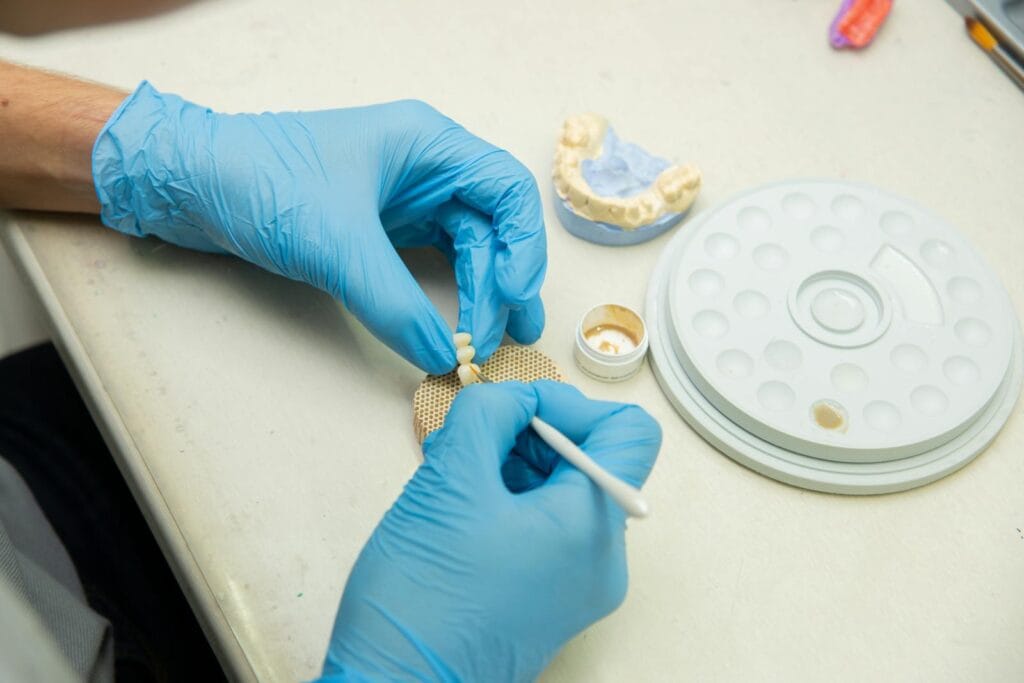
When you lose a tooth, two main options exist to replace it: a dental bridge or a dental implant. Both restore your ability to chew, speak, and smile with confidence, but they work in fundamentally different ways. Understanding the differences helps you choose the right solution for your situation.
Every smile is different. Message Dr. Rita and she will look at your case personally and guide you on the next step.
Ask Dr. Rita on WhatsAppPrefer to explore first? See how to reach us.
How a Dental Bridge Works
A dental bridge literally bridges the gap left by a missing tooth. It consists of an artificial tooth (pontic) held in place by crowns cemented onto the adjacent natural teeth. These supporting teeth are called abutments and must be trimmed down to accept the crowns.
Pros: Faster treatment (completed in two visits over one to two weeks), no surgery required, lower upfront cost, proven track record spanning decades.
Cons: Requires grinding down healthy adjacent teeth, does not prevent bone loss in the gap, average lifespan of 7 to 15 years before replacement is needed, harder to clean underneath.
How a Dental Implant Works
A dental implant is a titanium post surgically placed into the jawbone. Over three to six months, it fuses with the bone through a process called osseointegration. A crown is then attached to the implant, creating an independent replacement tooth that does not rely on adjacent teeth.
Pros: Preserves adjacent teeth (no grinding needed), prevents jawbone loss, can last a lifetime with proper care, looks and functions exactly like a natural tooth, easy to clean.
Cons: Requires minor surgery, longer treatment timeline, higher upfront cost, requires sufficient bone density (bone grafting may be needed).
When to Choose a Bridge
A bridge may be the better choice if the teeth on either side of the gap already need crowns (so trimming them is not a sacrifice), if you want a faster result without surgery, if medical conditions make implant surgery inadvisable, or if budget is the primary concern.
When to Choose an Implant
An implant is usually the better long-term investment if the adjacent teeth are healthy and you want to preserve them, if you are missing the tooth in a visible area and want the most natural result, if you want a permanent solution that can last decades, or if you are replacing a molar where chewing forces are highest.
Our Approach at Lebanon Dental Studio
At Lebanon Dental Studio, Dr. Rita Kanbar designs and fabricates bridges and implant-supported crowns as a prosthodontist. Our oral surgery specialists handle implant placement. This collaborative approach ensures that both the surgical and prosthetic phases are planned together for the best outcome.
Bridge vs Implant: Full Comparison Table
| Factor | Dental Bridge | Dental Implant |
|---|---|---|
| Upfront Cost (Lebanon) | Lower – similar baseline range | Slightly higher per tooth than a bridge unit |
| Longevity | 7 – 15 years | 20+ years (lifetime for the post) |
| Procedure Time | 1 – 2 weeks, no surgery | 3 – 6 months including healing |
| Bone Preservation | No – bone loss continues under the pontic | Yes – implant stimulates the jawbone |
| Adjacent Teeth Impact | Requires trimming healthy teeth | No impact on neighbouring teeth |
| Cleaning | Requires special floss threaders | Normal brushing and flossing |
| Surgery Required | No | Yes (minor, under local anaesthesia) |
| Success Rate | 90%+ at 10 years | 95%+ at 10 years |
Cost Comparison: Short-Term vs Long-Term
At first glance, a dental bridge appears cheaper than an implant. However, the long-term economics often tell a different story.
A bridge typically lasts 7 to 15 years before it needs replacement. Over a 30-year period, you may need two or three bridges for the same gap, each requiring new crowns on the supporting teeth. The cumulative cost can exceed the one-time investment of an implant.
An implant, by contrast, is a one-time surgical placement. The titanium post can last a lifetime. The crown on top may need replacement after 10 to 15 years, but this is a simpler and less expensive procedure than replacing an entire bridge.
Additionally, bridges do not prevent bone loss. Over the years, the jawbone under the pontic shrinks, which can affect facial appearance and eventually compromise the fit of the bridge itself. Implants actively preserve bone, avoiding this problem entirely.
Real Patient Considerations
Clinical data and comparison tables are helpful, but real decisions often come down to personal circumstances. Here are some factors our patients weigh when choosing between a bridge and an implant.
Time constraints: Diaspora patients visiting Lebanon for a limited period sometimes prefer a bridge because it can be completed in one to two weeks. An implant typically requires two trips spaced months apart. However, for patients who visit Lebanon regularly, the implant timeline fits naturally into their travel schedule.
Health and age: Implants require sufficient bone density and good general health. Patients with uncontrolled diabetes, heavy smoking, or certain medical conditions may be better candidates for a bridge. Conversely, younger patients tend to benefit most from implants because the long-term bone preservation and durability justify the investment over decades of use.
Condition of adjacent teeth: If the teeth on either side of the gap are already damaged, crowned, or heavily filled, preparing them for a bridge involves little additional sacrifice. But if those teeth are healthy and untouched, trimming them for a bridge means permanently altering sound tooth structure, which most patients and dentists prefer to avoid.
Multiple missing teeth: When several teeth in a row are missing, an implant-supported bridge (two implants supporting a multi-unit bridge) is often the most efficient solution. It provides the bone preservation benefits of implants without requiring one implant per tooth.
We will always recommend the option that is best for your specific situation, not the most expensive one. WhatsApp us at +961 71 677 261 to discuss your case.